Space for Inspiration 2026
https://bsgn.esa.int/s4i-2026/
The European Space Agency with the Ministry of Higher Education and Science Denmark will host companies, researchers and investors working at the front edge of commercial space exploration with the theme, "Scaling Research and Production in Space." The conference will highlight four markets with new opportunities for research and production in space. €289-€558. Copenhagen, Denmark. September 1-2, 2026.
|
3rd Space Visions Symposium
https://cctsonline.org/space-visions-symposium-3/
The Canaveral Council of Technical Societies brings Karman Line Co-Founder Jim Thomas alongside other speakers to discuss requirements for structures and systems to support space exploration and settlement, construction of large structures in space, logistics support, and in-orbit spacecraft services. $20-$50. Rockledge, FL. September 11, 2026.
|
World Space Business Week
https://wsbw.com/
Connect with decision-makers, investors and partners in the global space ecosystem from over 600 organizations representing more than 60 countries. Speakers include Firefly CEO Jason Kim, Seraphim CEO and General Partner Mark Boggest, and Vast CEO Max Haot. Paris, France. €660-€3,740. September 14-17, 2026.
|
AAS Glenn Space Technology Symposium
https://astronautical.org/events/john-glenn-memorial-symposium/
The symposium kicks off Ohio Space Week's collection of events, networking functions, tours, and more. Under the theme, "Igniting America’s Future Space Exploration," the program will include Exploration Architecture, the Artemis program, Space Traffic Management, Space Nuclear Power, and Navigation and Communications. $25-$895, Cleveland, OH. September 15-16, 2026.
|
Space Defense & Security Summit
https://sds-summit.com/
The 3rd SDSS will feature organizations representing the space and security community with speakers covering major themes in the industry, such as contestation in space, new cooperation models and investments and how defense space activities are organized. The proximity of the summit to World Space Business Week and the Space Innovation Summit also allows participants to participate in multiple events. €792-€2,585. Paris, France. September 15-16, 2026.
|
AMOS Conference
https://amostech.com/
The 2026 Advanced Maui Optical and Space Surveillance Technologies Conference features a multi-day program on Space Situational/Domain Awareness including Technical Short Courses, the EMER-GEN® program for young professionals, Policy Forum discussions, featured presentations and technical sessions, plus poster sessions, exhibit receptions and special events. $150-$2,295. Virtual and in-person: Maui, HI. September 15-18, 2026.
|
Ohio Space Week
https://www.orbitohio.com/ohio-space-week
Celebrate Ohio's ongoing contributions to aeronautics and space exploration at three events. AAS Glenn Space Technology Symposium focuses on technological developments in propulsion, power, and workforce development for space exploration. Ohio Space Forum gathers industry leaders, researchers, and policymakers to discuss hard-tech startup growth, space health and human performance, lunar energy solutions, space policy, and emerging nuclear space technologies. NASA Discovery Days features interactive, family-friendly events, hands-on simulations, Artemis exhibits, and opportunities to meet NASA engineers and scientists. Cleveland, OH. September 15-19, 2026.
|
Space Innovation Summit (SPIN)
https://wsbw.com/space-innovation-summit/
SPIN brings together influential voices shaping space innovation to share insights and inspiration. SPIN highlights the latest thinking in innovation, dual-use technology, and strategic collaboration from key players in the space sector. Hosted in synergy with the World Space Business Week and the Space Defense & Security Summit. €660-€3,740 Paris, France. September 16, 2026.
|
Inaugural Texas Space Summit 2026
https://www.texasspacesummit.com/
This Texas-led effort to drive humanity's expansion into deep space emphasizes a collaborative environment for industry leaders, policymakers, investors, and innovators while highlighting Texas's leadership in the space sector. $795. San Antonio, TX. September 21-23, 2026.
|
Seattle Space Week 2026
https://www.spacenorthwest.org/seattle-space-week
Pacific Northwest space community leaders, founders, technologists, and builders will gather for multiple events, including Space Northwest Symposium, Seattle European American Air Forum, Manufacturing the Future in the PNW, and Asian Leaders in Space Tech. Speakers include Interlune CEO Rob Meyerson, Portal Space CEO Jeff Thornburg and Stoke Space CFO Tim Beard. $240-$350. Seattle, WA. September 28, 2026 - October 4, 2026.
|
28th Small Payload Ride Share Association Symposium
https://www.sprsa.org/
Under the theme "Changing Space Priorities & New Challenges," this year's SPRSA Symposium will cover the pending LEO environmental crisis, new civil space priorities, contested space & resilience, assessing the role of space logistics, and SPRSA community support initiatives. $400-$600. Silicon Valley, CA. September 29, 2026 - October 1, 2026.
|
Strategies in Satellite Ground Segment 2026
https://www.ssgsconference.com/
SSGS, the only conference dedicated exclusively to the satellite ground segment, returns to explore opportunities and vendor capabilities, share insights and solutions revolutionizing bandwidth and connectivity, as well as celebrate Strategies in Satellite Ground Segment 2026 awardees. £220-£250. London, UK. September 30-October 1, 2026.
|
AEROTEC 2026 International Aerospace Technology Fair
https://www.aerotec.or.kr/index_en.php
AEROTEC is South Korea's premier international trade exhibition dedicated to advanced aerospace and aviation technologies showcasing advancements across aerospace systems engineering, propulsion, structures & materials, avionics, guidance & control, defense, satellite tech, Urban Air Mobility, and MRO (Maintenance, Repair, and Overhaul). 0-10,000 KRW. Changwon, Republic of Korea. September 30-October 2, 2026.
|
International Astronautical Congress 2026
https://www.iac2026.org/
The 77th International Astronautical Congress (IAC 2026) is organized by the International Astronautical Federation (IAF) and will be hosted by the Turkish Space Agency (TUA). The event gathers over 6,000 space sector professionals and researchers, with 2026's core theme "The World Needs More Space" emphasizing international cooperation, space safety, accessibility, and peaceful exploration. €0-€1,950. Antalya, Turkey. October 5-9, 2026.
|
14th European Space Power Conference
https://atpi.eventsair.com/espc2026/
The 14th European Space Power Conference (ESPC 2026), organized by ESA's (European Space Agency) Power Systems Division, will bring together space power professionals from industry, government agencies, and academia to address key topics including power management, solar generators, energy storage, and nuclear power. €480-€1,500. Estoril, Portugal. October 5-9, 2026.
|
Up/Link SpaceTech Business Summit
https://www.uplinksummit.com/
Up/Link: The SpaceTech Business Summit is a two-day, invitation-reviewed executive gathering capped at 200 attendees, focused on capital formation, commercial adoption, and structured deal-making through curated 1:1 meetings. Day one covers capital markets, insurance, banking, and venture selection, with speakers from NYSE and Fidelity Investments; day two addresses commercial and defense procurement, lunar resources, low-gravity manufacturing, and orbital compute. $475–$3,950. New York, NY. October 20–21, 2026.
|
Silicon Valley Space Week
https://svspaceweek.com/
This year's SVSW focuses on space defense tactics, secure satellite communications, and improving collaboration between commercial tech companies and government/military buyers. Professionals in the space sector are invited to the Satellite Innovation Conference targeting commercial space, and the MilSat Symposium, targeting national security and defense. $150-$1,895. Online and in-person in Mountain View, California. October 27-29, 2026.
|
Challenges | Solicitations | Resources
|
NASA Space Roboticist Challenge
https://spaceroboticistchallenge.com/
Selected researchers will run experiments on the Fly Foundational Robots' 7-Degree-of-Freedom robotic arm mission in low Earth orbit. Teams gain access to simulation and validation facilities at Goddard Space Flight Center, working directly with NASA engineers on your experiment design. Launch Webinar: June 24, 2026. Registration Close Date: September 23, 2026.
|
NASA TechLeap Orbital Clarity Challenge
https://occ.nasatechleap.org/
NASA's Orbital Clarity Challenge, the sixth in its TechLeap Prize series, invites applicants to propose low-cost, scalable approaches for measuring atmospheric density, pressure, or drag in low Earth orbit (LEO) to enable safer, more predictable satellite flight paths. Up to four winners will each receive up to $500,000 across three prize phases, with NASA also offering winning teams a complimentary LEO flight demonstration, bringing the total award pool to $2 million. A virtual information session is scheduled for September 22, 2026, with Phase 1 registrations closing October 28 and submissions due November 11, 2026.
|
Rock and Roll with NASA Challenge
https://www.herox.com/NASARockandRoll
NASA is seeking innovative designs for a lightweight, compliant and durable rover wheel capable of carrying heavy cargo, handling freezing lunar nights and sprinting across sharp regolith at 24 km/h. The phased challenge is open to students, independent inventors and aerospace firms. The current phase Involves live physical prototype testing at the NASA Johnson Space Center Rock Yard. Prize: $155,000. Submission Deadline: November 4, 2025.
|
NASA TechPort
https://techport.nasa.gov/help/fundingOpportunities
TechPort is designed to help external innovators, companies, researchers, and students find appropriate avenues to fund and develop technology in collaboration with NASA. The Interactive Funding Locator Tool allows users to scan open or upcoming NASA opportunities while the Direct Access to Official Space Agency Portals point users to the selection, evaluation, and proposal submission frameworks across NASA's primary directorates.
|
Add your event or campaign. Contact us for details.
|
Space Ecosystem | Startups | Deals
|
Castelion hits $13B valuation to mass-produce hypersonic missiles
https://techcrunch.com/2026/08/20/castelion-hits-13b-valuation-to-mass-produce-hypersonic-missiles/
Castelion, a hypersonic missile manufacturer founded in 2022 by former SpaceX executives, raised a $1 billion Series C at a $13 billion valuation, comprising $800 million in equity and a $250 million revolving credit facility. The round was co-led by Andreessen Horowitz, Carlyle, and JPMorgan Chase, with participation from existing investors Lightspeed, General Catalyst, and Altimeter. The Torrance, California-based company, which has secured more than $500 million in U.S. military contracts, will deploy the capital to produce its Blackbeard hypersonic missiles and other weapons at its New Mexico facility.
|
Ursa Major To Go Public Via SPAC
https://aviationweek.com/defense/missile-defense-weapons/ursa-major-go-public-spac
Rocket propulsion and hypersonic weapons company Ursa Major Technologies announced a SPAC merger with Bleichroeder Acquisition Corp. III valuing the company at $2.3 billion post-transaction. The deal includes $350 million in PIPE (private investment in public equity) commitments plus access to a further $345 million, with Ursa Major targeting a Nasdaq listing in Q1 2027. Proceeds will fund scaling of its solid rocket motor business and its Havoc hypersonic missile program, which has completed two U.S. Air Force flight tests. Founded in 2015, the company reported $45 million in 2025 revenue and projects $101 million in 2026, with a near-term pipeline it values at $2.8 billion.
|
Muon Space Raises $250M Series C to Build Large-Scale Constellations
https://www.satellitetoday.com/finance/2026/08/20/muon-space-raises-250m-series-c-to-build-large-scale-constellations/
San Jose–based satellite manufacturer Muon Space raised $250 million in Series C funding led by Eclipse, valuing the company at $1.5 billion and taking its total equity raised past $386 million. The oversubscribed round included strategic backers Google and Salesforce Ventures alongside Galvanize, Wellington Management, I Squared Capital, Toyota's Woven Capital, and existing investors Radical Ventures, Costanoa Ventures, and others. Proceeds will scale production to up to 500 small satellites per year by 2027 to address a backlog of over 50 satellites for defense, civil and commercial clients. Funds will also advance development of on-orbit AI compute, higher-power spacecraft, and real-time ultra-high-bandwidth optical/RF communications.
|
Japanese space tech startup Letara expands beyond satellite thrusters with $16M
https://techcrunch.com/2026/08/21/japanese-space-tech-startup-letara-expands-beyond-satellite-thrusters-with-16m/
Sapporo-based space propulsion startup Letara raised ¥2.6 billion (approximately $16 million) in Series A extension funding co-led by Headline Asia, JIC Venture Growth Investment (JIC VGI), and Incubate Fund, with participation from NES Corporation, Toyoda Gosei, and JAXA-backed Frontier Innovations. The capital is slated for scaling manufacturing, defense certifications, and executing an upcoming in-orbit test firing of its solid fuel / liquid oxidizer hybrid rocket thruster. The company's proprietary hybrid design separates solid fuel, using inexpensive materials such as plastic and rubber, from liquid oxidizer, aiming to deliver higher thrust and lower waste than conventional hybrid rockets.
|
Space Exploration | Development
|
White House Targets Support for 1,000 Launches Per Year by 2030
https://www.satellitetoday.com/government-military/2026/08/21/white-house-targets-support-for-1000-launches-per-year-by-2030/
The White House released a National Security Presidential Memorandum setting a target of more than 1,000 U.S. launches and reentries annually by 2030, up from 193 orbital launches in 2025. The policy directs federal agencies to expand launch and reentry infrastructure, expedite permitting and environmental reviews, prioritize airspace for launch corridors, update export policies, and incentivize public-private partnerships. The memorandum replaces the 2013 Obama-era National Space Transportation Policy and comes amid clear signs of launch market constraint: SpaceX's Starship remains uncommercial, competitors Blue Origin and ULA have faced vehicle issues, and SpaceX is reportedly no longer accepting new rideshare reservations beyond late 2028.
|
Starbase, LA
https://www.spacex.com/sites/starbase-la
SpaceX plans to begin construction in 2027 on "Starbase Louisiana," a planned $100 billion spaceport featuring 10+ launch towers designed for high-frequency Starship operations, intended to eventually support thousands of flights annually. The self-sustaining industrial hub will have on-site methane propellant production, deep-water docks, an airport, power plants, and employee housing. The project is expected to create 3,000 direct jobs and over 8,000 indirect jobs with first launches targeted for 2029–2030.
|
The floodgates are open after another Chinese company lands a reusable rocket
https://arstechnica.com/space/2026/08/the-floodgates-are-open-after-another-chinese-company-lands-a-reusable-rocket/
Chinese commercial launch company LandSpace successfully recovered the first stage of its methane-fueled Zhuque-3 (ZQ-3) rocket on August 19, marking China's first successful land-based booster recovery using landing legs, just 40 days after CASC's Long March 10B became the first Chinese rocket to recover a booster via a net-catch platform at sea. The 66-meter ZQ-3 can deliver over 8 metric tons to LEO in reusable configuration, with an upgraded variant targeting 18.3 metric tons. LandSpace is positioning the rocket to serve Chinese satellite mega-constellations Guowang and Qianfan, which officials project will require 700–800 launches over the next seven to ten years. With several additional Chinese reusable rockets (including the Long March 12A, Long March 12B, Pallas-1, Hyperbola-3, and Tianlong-3) potentially flying before year-end, China's collective reusable launch capability is accelerating at a pace that could challenge US launch market dominance.
|
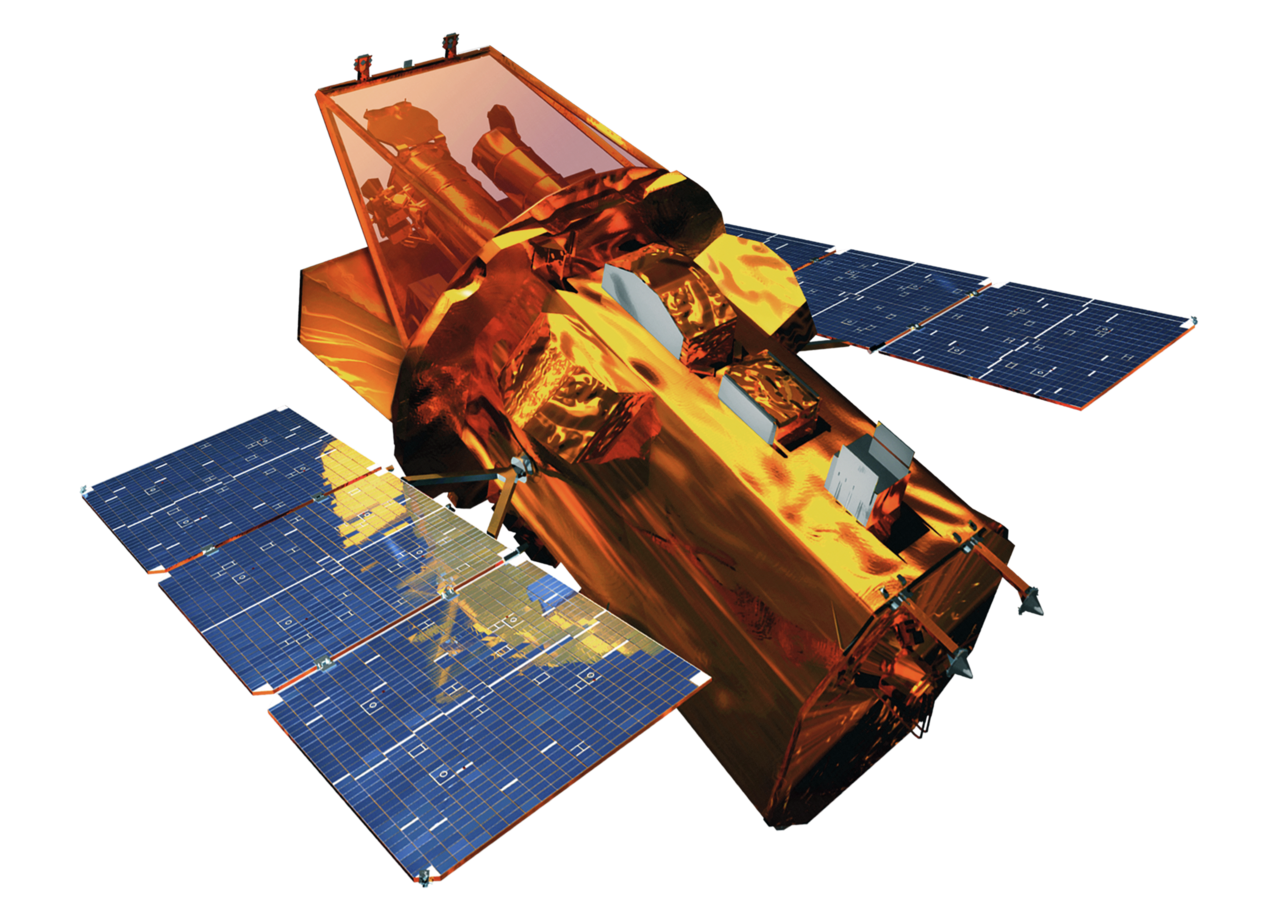
NASA's Swift Gamma Ray Burst Detecting Satellite. Image Credits: NASA E/PO, Sonoma State University/Aurore Simonnet
|
Astronomy | Astrobiology | Cosmology
|
NASA’s Dark Universe-Seeking Nancy Grace Roman Space Telescope Launches
https://www.nasa.gov/news-release/nasas-dark-universe-seeking-nancy-grace-roman-space-telescope-launches/
NASA's Nancy Grace Roman Space Telescope launched on August 30 aboard a SpaceX Falcon Heavy rocket from Kennedy Space Center, beginning a three-month, one-million-mile journey to the second Sun-Earth Lagrange point (L2). The flagship mission, delivered ahead of schedule and on budget, features a 300-megapixel wide-field infrared camera capable of surveying the universe 1,000 times faster than Hubble, and will transmit 1.4 terabytes of data daily, the highest rate of any NASA astrophysics mission. Roman's primary science objectives include mapping dark matter and dark energy, cataloging exoplanets, and demonstrating coronagraph technology that could enable future imaging of Earth-like planets. First images are expected by early 2027.
|
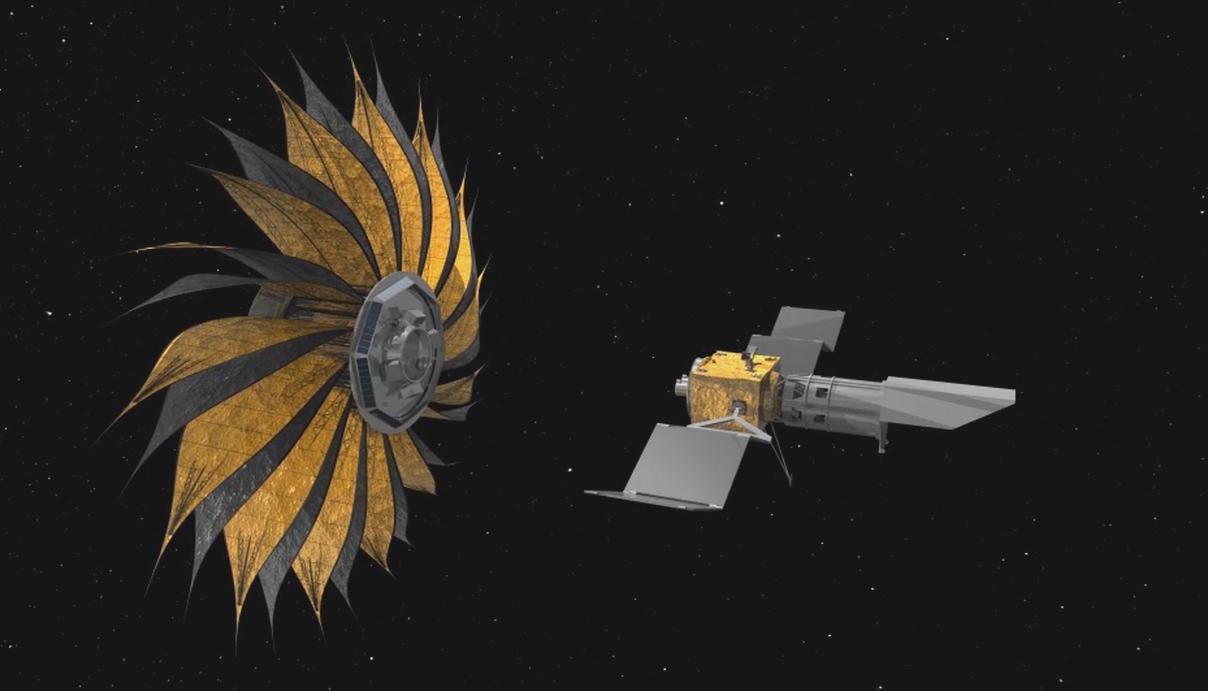
An artist's rendering of NASA's proposed giant sunflower-like structure called starshade flying in sync with a space telescope. Image Credits: NASA/JPL
|
NASA Starshade Would Enable Astronomers To Directly Image Rocky Exoworlds
https://www.universetoday.com/articles/nasa-starshade-would-enable-astronomers-to-directly-image-rocky-exoworlds
A NASA-led team has proposed the Hybrid Observatory for Earth-like Exoplanets (HOEE), which would pair an orbital starshade positioned ~175,000 km from Earth with next-generation ground-based telescopes — initially the European Southern Observatory's Extremely Large Telescope in Chile, expected to achieve first light by late 2030 — to directly image rocky, Earth-sized exoplanets within 20 light-years. HOEE would analyze atmospheric spectral lines, searching for red/green auroral signatures that indicate nitrogen- and oxygen-rich atmospheres. The starshade, featuring 48 petals each 24.5 meters long and a 50-meter central disk, would block a parent star's light, enabling detection of planets up to a billion times fainter than their host stars. Current instruments including the James Webb Space Telescope and the Roman Space Telescope cannot directly observe Earth-like exoplanets in optical light, making HOEE a potential breakthrough for detecting chemical biosignatures.
|
|
|
|
|