CyberSat 2026
https://www.cybersatsummit.com/
CyberSat 2026, now in its 10th year, is a four-day space cybersecurity forum featuring both unclassified and classified (TS/SCI) programming, covering AI-driven threats, satellite network defense, nation-state TTPs (tactics, techniques, and procedures), and live on-stage hacking demonstrations. Keynote speakers include US Space Force Deputy Chief for Cyber and Data Charleen Laughlin, Assail CEO Alissa Knight, and National Reconnaissance Office Deputy Commander Lt. Col. Luke Shibilski. $299–$1,199 (unclassified); classified add-on $349–$599 extra. Reston & Chantilly, VA. November 2–5, 2026.
|
Space Policy and Law Course for 2026
https://www.space-institute.org/space-policy-and-law-course-2026-cpd/
The London Institute of Space Policy and Law invites government policymakers, space agency personnel, military officers, satellite operators, insurers, lawyers, and post-graduate researchers to its Space Policy and Law Course 2026. The interactive online course is 15 hours with CPD accreditation for Solicitors and Barristers in England and Wales, and covers space environment, technology basics, orbit characteristics, and orbit management alongside more specialized legal frameworks and security and governance. £1,550. Online. November 2-4, 2026.
|
APSCC 2026
https://apsccsat.com/
The 27th annual APSCC (Asia-Pacific Satellite Communications Council) Space Conference & Exhibition will gather satellite and space industry professionals across the Asia-Pacific region to discuss connectivity, market insights, and partnership opportunities under the theme "Fueling the Asia-Pacific Space Economy." The three-day event will feature panel discussions, case studies, executive interviews, and an exhibition showcasing the latest satellite and space technologies. Denpasar, Indonesia. November 3–5, 2026.
|
The 8th Summit for Space Sustainability
https://www.swfsummit.org/
The 8th Summit for Space Sustainability, co-hosted by the Secure World Foundation, the Brazilian Space Agency (AEB), and the Secretariat of Science, Technology and Innovation of the Federal District, will convene policymakers, industry leaders, and researchers to advance practical solutions for long-term space sustainability. Marking the first time the summit is held in Latin America, the agenda covers debris mitigation, space governance, Earth observation applications, and sustainability principles for lunar and Martian activities. Attendees will also have the opportunity to sign ESA's Zero Debris Charter, a community-driven initiative with over 250 signatory organizations from 35 countries. $25-$250. Brasília, Brazil. November 4-5, 2026.
|
NASA MAX POWER
https://www.nasa.gov/maxpower/
MAX POWER is a public aerospace exposition and airshow showcasing American air and space technology in honor of the 250th anniversary of the United States. Highlights and exhibits include historical NASA mission flight demonstrations, a technology showcase covering drones and autonomous vehicles, and next-generation flight concepts. The event focuses on progress within NASA's primary directorates and is designed to engage students, industry stakeholders, and the public in the future of US spaceflight and aviation infrastructure. Tickets for the different events range from $49.24 to $275. Merritt Island, FL. November 7-8, 2026.
|
Space & Satellites USA 2026
https://events.reutersevents.com/space/space-satellites-usa
Space & Satellites USA 2026 is an invitation-only, 250-person senior executive summit focused on orbital scale, cybersecurity, and defense acquisition strategy, featuring Chatham House roundtables and debates. Confirmed speakers include NASA Administrator Jared Isaacman, Firefly Space CEO Jason Kim, Apex Space CEO Ian Cinnamon, and Northwood CEO Bridgit Mendler. $0-$2,499. Washington, D.C. November 9-10, 2026.
|
CAL-SPACE
https://cal-space.com/
CAL-SPACE 2026 is a two-day California Space, Propulsion and Aerospace Conference and Expo connecting commercial space, defense, propulsion, manufacturing, capital and workforce stakeholders across the full aerospace value chain. Sessions will cover Space Force launch and range modernization, national security space architecture, on-orbit AI, propulsion and hypersonics, and defense industrial base challenges. Free. Mojave, CA. November 12-13, 2026.
|
Kentucky Space Summit
https://www.kyspacefutures.com/kentucky-space-summit-2
The inaugural Kentucky Space Summit, hosted by Kentucky Space Futures, will convene business, research, education, and policy leaders to explore how Kentucky can expand its role in the global space economy, projected to exceed $1.7 trillion by 2035. The agenda spans exomedicine in microgravity, lunar base development, and aerospace manufacturing, concluding with a facilitated session on crafting a 5-10 year Kentucky space strategy. Featured speakers include Dr. Meenal Datta (Notre Dame), Dr. Tiffany Vora (President, Explore Mars), and Greg Schmidt (former NASA Solar System Exploration Institute Director). $25-$75. Lexington, KY. November 13, 2026.
|
33rd Space Simulation Conference
https://www.iest.org/meetings/space-simulation-conference
The IEST (Institute of Environmental Sciences and Technology) Space Simulation Conference is a international forum on space hardware environmental testing, bringing together engineers, technicians, and scientists from industry, government, and academia to present and exchange ideas on simulating the space environment for R&D and qualification. The conference is supported by NASA, Johns Hopkins University Applied Physics Laboratory, MIT Lincoln Laboratory, and Northrop Grumman. Annapolis, MD. November 16-19, 2026.
|
Golden Age of Space
https://www.eventbrite.com/e/golden-age-of-space-tickets-2002638296053
Washington Times event bringing together military leaders, members of Congress and aerospace defense stakeholders to discuss how the U.S. can maintain leadership in a contested space domain against expanding capabilities from China and Russia. Topics and panels include the Golden Dome, setting the 21st-century pace for access to space, and the cislunar economy. Speakers include NASA Administrator Jared Isaacman, Chief of Space Operations Gen. Douglas Schiess, and select senators and congressmen. Free. Arlington, VA. November 17, 2026.
|
9th Space Tech Expo Europe
https://www.spacetechexpo-europe.com/
Space Tech Expo Europe, Europe's largest B2B space event, returns to Bremen for its 10th anniversary, convening the European space supply chain across launch services, satellite operations, communications, ground systems, and more, with four dedicated conferences covering industry, small satellites, connectivity, and a tech forum. $0–$350. Bremen, Germany. November 17-19, 2026.
|
The Americas Space Forum
https://americasspaceforum.com/
The Americas Space Forum makes its Latin American debut at the ECLAC (Economic Commission for Latin America and the Caribbean) headquarters in Santiago, bringing together senior policymakers, space agencies, regulators, and industry leaders to address regional cooperation, commercial growth, satellite connectivity, Earth observation, and space security. Free. Santiago, Chile. November 30 - December 1, 2026.
|
2026 Cislunar Security Conference
https://events.jhuapl.edu/event/CLSC/homeReg
This Johns Hopkins APL conference is the nation's largest cislunar-specific event, convening hundreds of professionals from government, industry, and academia. This year's theme, "Superiority in Cislunar Space: Technology, Security, and Vision," aims to uncover the technologies, partnerships, and policies required to enable sustained operations, mission assurance, and space superiority across the cislunar domain. Discussions cover space domain awareness, resilient communications, logistics, infrastructure, and security cooperation. Laurel, MD. December 1-3, 2026.
|
AGU Fall Meeting 2026
https://www.agu.org/annual-meeting
The world’s largest annual gathering of Earth and space scientists hosting over 25,000 attendees from over 100 countries, AGU26 will cover over 25 scientific sections bridging Earth sciences, planetary geology and space physics. Topics include planetary sciences and exoplanetary habitability, space physics and aeronomy, earth observation and remote sensing, and interdisciplinary data science and AI. $0-$1,320. San Francisco, CA with hybrid options. December 7-11, 2026.
|
Challenges | Solicitations | Resources
|
Rock and Roll with NASA Challenge
https://www.herox.com/NASARockandRoll
NASA is seeking innovative designs for a lightweight, compliant and durable rover wheel capable of carrying heavy cargo, handling freezing lunar nights and sprinting across sharp regolith at 24 km/h. The phased challenge is open to students, independent inventors and aerospace firms. The current phase Involves live physical prototype testing at the NASA Johnson Space Center Rock Yard. Prize: $155,000. Submission Deadline: November 4, 2026.
|
NASA International Space Apps Challenge
https://www.spaceappschallenge.org/
NASA International Space Apps Challenge is the world’s largest annual global hackathon, inviting all-age multidisciplinary teams to solve Earth and space science challenges using freely available NASA open data. The 2026 theme is "The Next Frontier," focusing on space exploration, AI, Earth observation, climate, and human discovery. Hundreds of in-person local host events worldwide will coincide with a global universal virtual event. Teams produce open-source solutions spanning software apps, data visualizations, AI/machine learning models, educational tools, and physical hardware prototypes. November 14-15, 2025.
|
Lunar Grounding Challenge
https://work.crowdplat.com/challenge/lunar-grounding-challenge
NASA's Tournament Lab challenge is seeking innovative engineering designs and operational solutions to safely neutralize extreme electrostatic charge buildup on astronauts returning from lunar surface Extravehicular Activities (EVAs) at the lunar South Pole. Phase 1 is open to submissions to identify promising design and operational concepts. Up to five finalists will be selected for Phase 2 to refine designs for final judging and prize allocation of $150,000 total. Submission deadline for Phase 1 is January 15, 2027.
|
NASA TechPort
https://techport.nasa.gov/help/fundingOpportunities
TechPort is designed to help external innovators, companies, researchers, and students find appropriate avenues to fund and develop technology in collaboration with NASA. The Interactive Funding Locator Tool allows users to scan open or upcoming NASA opportunities while the Direct Access to Official Space Agency Portals point users to the selection, evaluation, and proposal submission frameworks across NASA's primary directorates.
|
Add your event or campaign. Contact us for details.
|
Space Ecosystem | Startups | Deals
|
Satellite Bus Maker Apex in Talks to Raise $500M at $4B Valuation
https://satnews.com/2026/10/24/satellite-bus-maker-apex-in-talks-to-raise-500m-at-4b-valuation/
Satellite bus manufacturer Apex is in talks to raise approximately $500 million at a $4 billion valuation, with private investment firm Washington Harbour Partners set to lead the round and existing backers Andreessen Horowitz and XYZ Venture Capital participating. The deal comes just four months after Apex raised $200 million at a $2.3 billion valuation in June, reflecting rapid investor appetite for standardized upstream space hardware. Proceeds will fund facility expansion at its Factory One complex in Los Angeles, deeper vertical integration across its Aries and Nova bus assembly lines, and production scaling ahead of Golden Dome flight tests in 2027, where Apex is partnered with Northrop Grumman to supply orbital buses.
|
KP Labs €4.42M in Funding
https://www.finsmes.com/2026/10/kp-labs-e4-42m-in-funding.html
KP Labs, a Gliwice, Poland-based provider of in-orbit satellite data processing solutions, raised €4.42M in funding led by Momentum Capital Partners. The company delivers end-to-end hardware, software, and AI algorithms enabling real-time onboard data analysis for Earth observation, space robotics, and orbital operations, with existing customers including ESA, NASA, Airbus Defence and Space, and Thales Alenia Space.
|
JAOPS raises 260 million yen in seed round from UntroD Capital and Midtown Frontier Fund to realize "Operations as a Service" for space mission operations.
https://prtimes.jp/main/html/rd/p/000000003.000158023.html
Tokyo-based JAOPS, a satellite and space mission operations company, raised ¥260 million (approximately $1.7 million USD) in a seed round led by UntroD Capital and Midtown Frontier Fund, the latter founded by ispace co-founders. The company offers Operations as a Service (OaaS), providing outsourced mission control tools, simulators, and infrastructure to satellite operators, and already serves customers in six countries including Japan, the US, UK, Spain, France, and South Korea.
|
Space Exploration | Development
|
Japan launches mission to bring home a piece of the Martian moon Phobos
https://arstechnica.com/space/2026/10/japan-launches-mission-to-bring-home-a-piece-of-the-martian-moon-phobos/
JAXA’s historic Martian Moons eXploration mission, which successfully launched on October 19, 2026, aboard an H3 rocket from Tanegashima Space Center, is heading toward the larger Martian moon, Phobos, to collect at least 10 grams of surface regolith. Expected to arrive in August 2027, the MMX spacecraft will spend years studying both moons, deploying the small surface rover Idefix. The sample return capsule is scheduled to land in Australia in 2031. JAXA aims to analyze pristine samples from Phobos to resolve the mystery of the origin of Mars' moons while learning about planetary formation, water delivery, and the evolutionary history of the Martian system.
|
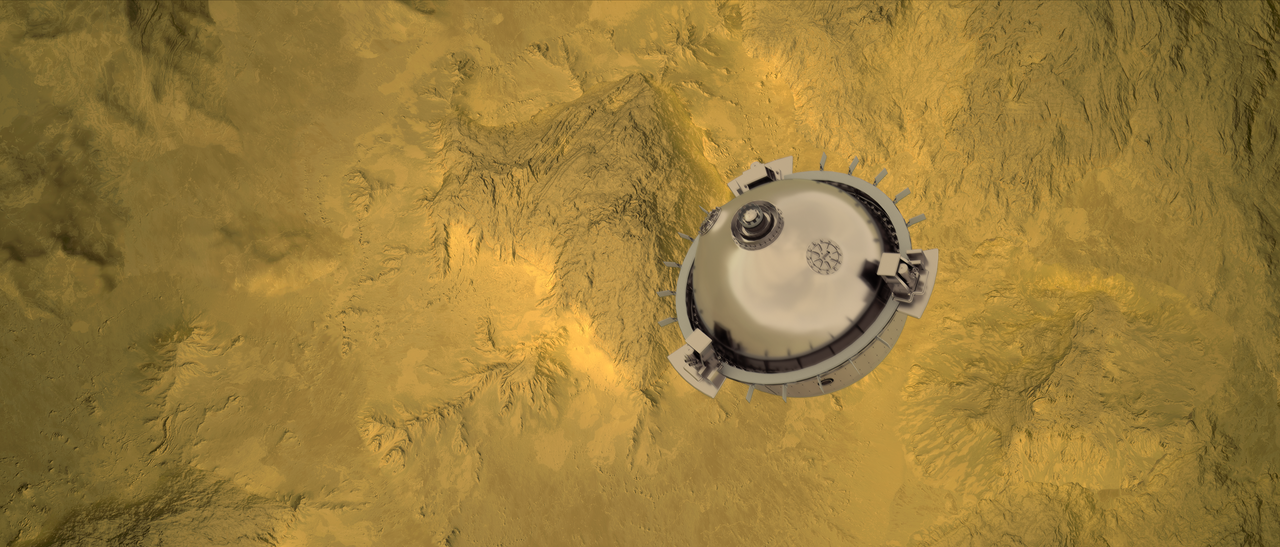
An artist's impression of DAVINCI+ atmospheric probe descending to the surface of Venus to explore the atmosphere from above the clouds to near the surface of terrain that may have been a continent, capturing images and chemistry measurements for the first time. Image Credits: NASA GSFC visualization by CI Labs Michael Lentz and others
|
Things are finally looking up for NASA’s first missions to Venus in a generation
https://arstechnica.com/space/2026/10/nasas-embattled-venus-missions-are-back-on-track-after-cancellation-threat/
NASA’s long-delayed and previously threatened Venus missions are officially back on track. DAVINCI is scheduled for launch in December 2030 to deploy a descent probe into Venus’ atmosphere and study whether the planet once hosted oceans or life. VERITAS is slated for launch in November 2032 to map the planet's surface using radar and infrared spectroscopy and study its geological evolution. The recovery of NASA's timeline coincides with Europe's upcoming Envision orbiter and potential commercial ventures, pointing toward a long-awaited decade of Venus missions after a generation without direct surface exploration.
|
Astronomy | Astrobiology | Cosmology
|
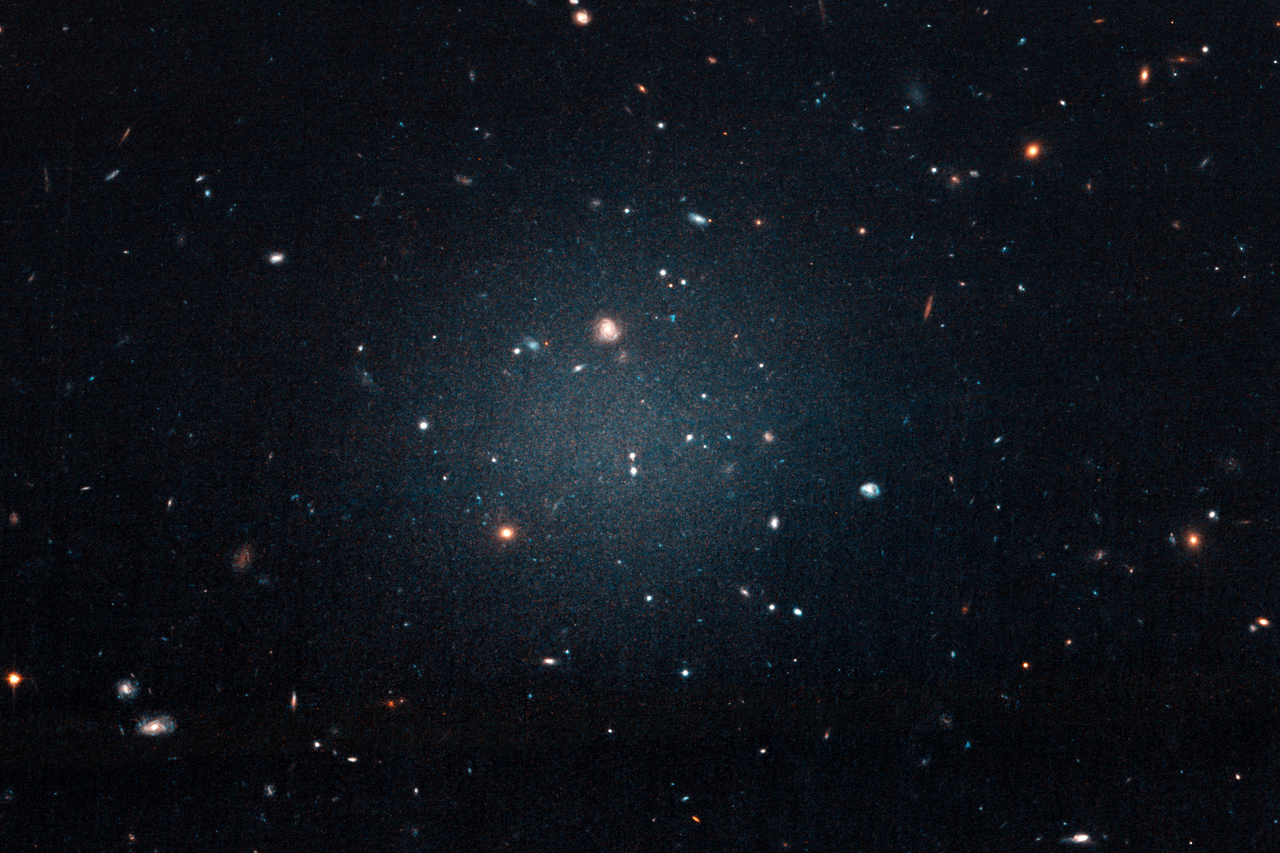
Hubble Views ‘Ghostly’ Galaxy Lacking Dark Matter. Image Credits: P. van Dokkum (Yale University)
|
Triplet of ‘Ghostly’ Galaxies Hints at What Dark Matter Is — and Isn’t
https://www.quantamagazine.org/triplet-of-ghostly-galaxies-hints-at-what-dark-matter-is-and-isnt-20261014/
Three 'ultra-diffuse' galaxies, DF2, DF4, and DF9, located roughly 65 million light-years away, have been found to contain little to no dark matter, a finding published in The Astrophysical Journal in June 2026. Researchers propose that an ancient galactic collision stripped these galaxies of their dark matter, which passed through the collision while ordinary matter clumped together, analogous to the well-documented Bullet Cluster event. The findings deal a significant blow to Modified Newtonian Dynamics (MOND), an alternative gravity theory, since the ability to physically separate dark matter from ordinary matter implies it is a tangible substance rather than a gravitational effect.
|
Watch the universe emerge from the dark ages, with Lumina
https://news.mit.edu/2026/watch-universe-emerge-from-dark-ages-with-lumina-1026
MIT, Harvard, and international physicists have published Lumina, a large-volume computer simulation spanning 500 megaparsecs (roughly 1.6 billion light-years) that models the universe's evolution from the cosmic dark ages through its first 2 billion years. Running on the Frontier supercomputer at Oak Ridge National Laboratory using over 100,000 CPU cores and 15,000 GPUs, Lumina processes half a trillion individual elements at 30x the resolution of its predecessor, IllustrisTNG. For the first time, a single simulation captures both hydrogen re-ionization, driven by early stars and galaxies, and helium re-ionization, fueled by supermassive black holes, in a volume 100 times larger than previous simulations. The team is releasing Lumina publicly to allow comparison with data from current and future telescopes.
|
|
|
|
|